Your idea.
A Glass app.
You know the web. Your AI can handle the native part. Start with a working app and build your idea from there.
Includes a working starter, three AI skills and English/German prompts. No account needed to download.
Companion includes Python, a compiler and the simulator for Macs with Apple silicon. Create your project there and open it in your AI editor. Your AI uses the project's glass-dev launcher; the manual setup and python3 commands below are for the separate starter kit.
Open the starter in your AI editor
Extract the ZIP, then open the whole glass-app-starter folder in your coding editor. Keep the .agents folder: it contains the skills your AI will use.
Your computer needs Python and a C compiler. The AI checks what is available and explains any setup. The optional interactive simulator has its own setup.
Describe one useful task
A checklist or a small local tool is a good first app. The prompt tells your AI which architecture, hardware and Glimmer-inspired components to use.
Read the prompt
The prompt first asks the AI to name the skill files it read and its target: C99, Glass Explorer, 640 × 360 and a computer preview. If it reports missing files, START-HERE lists the exact paths to attach.
Try it, then send it for review
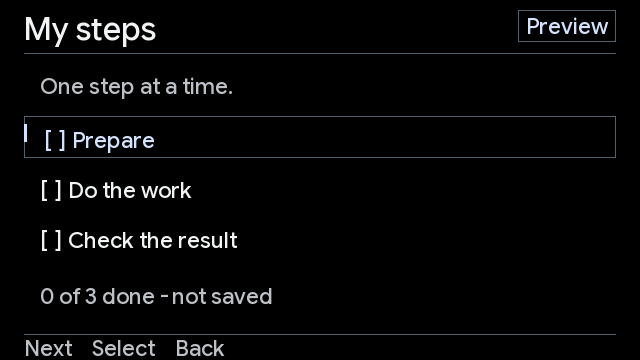
PNGs show what the app looks like; they are not interactive. Ask your AI to test selection, progress and cancellation with concrete inputs and show the before/after states. Describe changes until the app does what you want.
I want to operate the app myself
Send this follow-up request to your AI editor. It uses the simulator included in the kit and explains any extra setup:
Start my app in the included simulator using apps/simulator/README.md. Explain the keys for next, select, back and cancel. If Qt cannot be set up, test those inputs through the preview tool and show before/after images.When the checks pass, ask the AI to create the review package. It runs:
python3 tools/glass-app.py package my-stepsYour AI uses your app’s ID in place of my-steps. It gives you these files:
*-source.zip- The source package to upload. Includes code and actual preview images.
submission.json- The app details. Choose this in the submission form’s metadata import to fill the fields.
preview-en.png
preview-de.png- Open these images to check your app before sending it.
When submission is open, choose the source ZIP, check the app details and submit. Keep the receipt. A person reviews the app; uploading alone does not publish it or install it on Glass.
What happens after uploading?
The receipt identifies the exact file you sent. Check Your submissions for review notes. If changes are requested, update the app and send a new package. After an uncertain upload result, check that list before sending again.
Different apps. One visual language.
Google’s Glimmer is our design North Star: short, glanceable tasks, dark free space, bright content and a clear focus. The kit uses our shared C99 components so every app starts with the same typography, colors and navigation.
Google’s Glimmer design guidance ↗What environment does the AI target?
Google Glass Explorer, a 640 × 360 interface and our native Linux/C99 environment. The device build context is ARMv7 hard-float with musl. Glimmer guides the design; the Android XR Compose library is not the runtime used here. The starter runs locally; device installation and real optical readability need separate qualification.
Start with the local template. Camera, audio and network use platform services and need an explicit integration. Checking a capability in Store metadata does not activate hardware.
Stuck on a step?
Do I need to learn C first?
No. Tell your AI what the app should do and review the results. The included skills make it use the native starter. You can still inspect and change all source code.
The AI says Python or cc is missing
On macOS the Xcode Command Line Tools provide cc; on Linux use the usual C build tools. On Windows use WSL for this starter. Ask your AI for the setup matching your computer. Static previews do not need Qt or Docker.
Which file do I upload?
Choose the file ending in -source.zip from work/apps/your-app-id. Do not upload the whole starter kit, a host executable, an APK or your access file as the app package.
Where do my account details go?
Use the Store’s own account flow. In the local development portal, select your private developer access file only in the account field. Keep it outside the app folder and out of AI chats. It is not part of your package.